
From our correspondent in the Irish Republic
Nation-states need myths and a mythos to maintain themselves. That is, lies that are useful and a worldview to justify their existence. No two places has the exact same combination of elements that make up the web of lies. Some ruling classes emphasise the overwhelming military strength of ‘our’ country, their supposed cultural superiority over rivals or an imaginary (but powerful) uniqueness. Others are less emphatic.
The Irish elite prides itself on a supposed military neutrality. This is rooted in the reality of a centuries-long struggle against domination by British imperialism. In truth, there has always been some irony if not outright hypocrisy in this stance. For example, during World War II, the Irish government gave substantial practical assistance to the Allies. This included passing on captured German documents to MI5 and allowing US and Royal Air Force flights to overfly Irish airspace 1. You can argue whether this was a good thing or not, but it certainly isn’t neutrality as most people would understand it.
Fast forward to present times and Shannon Airport has been used by the U.S. Airforce for various actions, with the complicity of the Irish state. This goes back to at least the first Gulf War in 1991 and has continued through the war in Iraq to the present day. The campaign group Shannonwatch has estimated that since 2002 over 2.5 million U.S. troops have passed through Shannon. For example in 2005 there were over 6, 500 troops per week plus their weapons passing through the airport as well as contracted cargo planes and other military aircraft. There has also been evidence of Central Intelligence Agency (CIA) ‘rendition’ flights. In essence this has involved kidnapping people and taking them through Ireland on the way to be being tortured elsewhere. 2
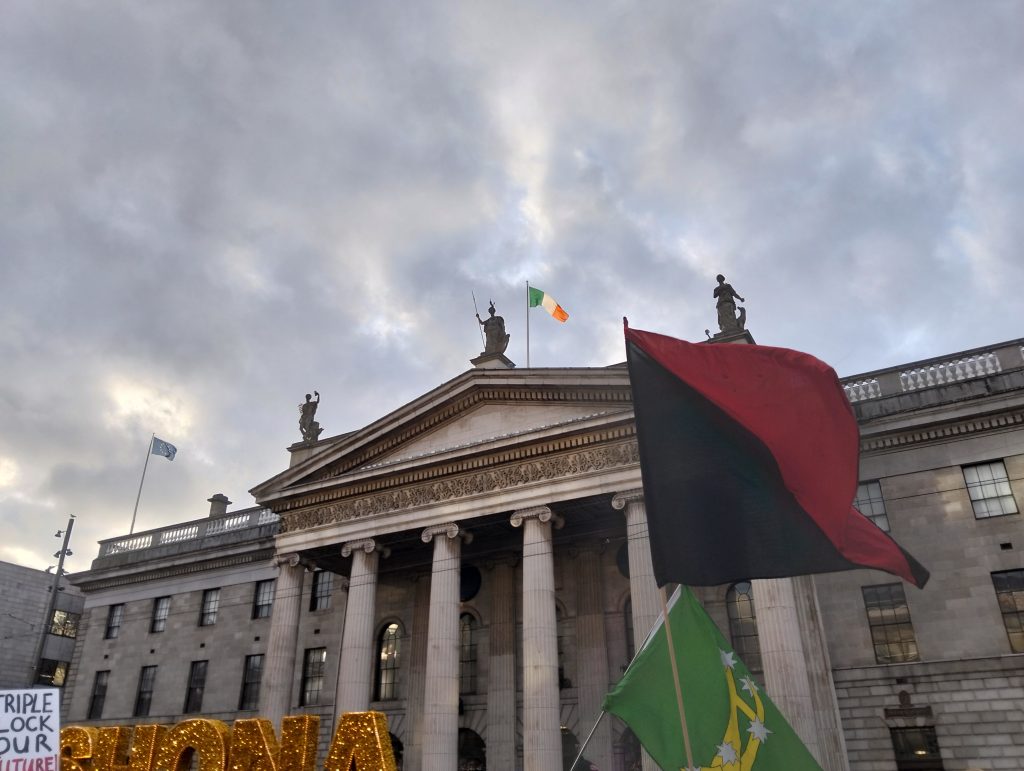
On a broader front, consider the double standard at play in relation to Ukraine and Palestine. In the case of the latter, the government has had to bow to immense pressure and recognise the state of Palestine but simultaneously dragged its feet in doing anything substantial against the Zionist-state. Before the election of 2024 it promised to enact the Occupied Territories Bill but waited till July 2026 to actually do it. When it came into force it was gutted of its full potential. While it banned the importation of goods from the Occupied Territories, it excluded services and these make up approximately 70% of Ireland’s trade with Israel 3
When it comes to Ukraine however, the treatment has been different. The Journal reported at the start of September that Irish Defence Minister McEntee is giving 10 million Euros (from a package of 125 million Euros already announced in July) for combat training in Ukraine.
The state has sent Irish Defence Forces to Europe to train Ukrainian government soldiers in combat drills, mine clearance and battlefield medical care. The government had previously said it would not provide offensive supplies such as weapons and ammunition. This is a clear change in policy as these moves entail direct funding to the Ukranian state military as part of the European Union (EU) ‘training mission’ there. McEntee was quoted as saying that the facility being funded is a “critical piece of infrastructure for them in their combat and in their training priorities at the moment” 4.
One of the planks of Irish state pseudo-neutrality, is the Triple Lock. This refers to three conditions being met for more than 12 Irish Defence Forces personnel to be dispatched overseas as part of an armed mission. It must have United Nations approval backed by a resolution, secondly it must be approved by the Irish government and lastly, be voted on and approved by the Dail.
The current centre-Right coalition of Fianna Fail/Fine Gael is making moves to dismantle the Triple Lock. The Defence (Amendment) Bill 2026 proposes to eliminate the UN approval requirement, raising numbers to 50 personnel with Dail approval and allowing deployments with government approval only. The Bill has gone through its second reading and passed narrowly, but will need another vote in the Dail to become law.
This latest development has caused concern among an assortment of groups. Beginning with parties within the Dail, there are representatives in Fianna Fail itself who are sceptical of the changes. This perhaps hints at the closeness of the recent vote and the fragility of the leadership of Taoiseach Micheal Martin. Though at this point, there aren’t enough dissenters to kill the bill or to initiate any factional challenge over the issue.
Sinn Fein is currently riding high in the polls and is the main alternative party to the present coalition. They have held public meetings on the Triple Lock and rhetorically spoken against the Bill. However, their primary call is for a referendum on the issue. There is absolutely no incentive for the government to initiate such a measure and critically under Article 46 of the constitution, such a referendum cannot be initiated by the public. It is therefore in effect an opportunity for Sinn Fein to grandstand on the topic. Even if they were subsequently to attain power, their priorities could change and its up to them rather than the people to determine what would happen.
Among the minor parties with Dail representation, Aontu (a splinter from Sinn Fein) generally advocates for economically interventionist policies but has greater social conservatism than most. It has also held public meetings over the Triple Lock. Their stance is against any change but motivated by the desire for a more nationalist-minded armed neutrality, akin to Switzerland. The other parties such as Labour and Social Democrats are closer to Sinn Fein in their motivational opposition.
The most rhetorically radical party within the Dail is People Before Profit (PBP). They highlight a lot of the contradictions in the conventional perception of neutrality and note the role of imperialism in shaping the geo-political landscape the Irish state operates within. While in speeches they tend to dispense with overtly Leninist jargon, they aren’t afraid to quote him and Trotsky or Connolly in print.
Despite doing some useful work in skewering the mainstream parties, PBP need to be viewed cautiously. They have taken seats in the Dail and this positions them as contenders to wield power on behalf of the state. No doubt their policies and use of the instruments of power would look different to contemporary arrangements. Nevertheless, PBP see things in terms of nation-states and would undoubtedly adhere to (an admittedly contrasting) range of contradictions themselves. Take for example their ‘revolutionary’ rhetoric sitting alongside commentary on “…the scourge of low pay in the Defence Forces. People Before Profit has been consistent in calling for decent pay and conditions for these workers” 5. It’s true that the military recruits from the working class, but once in uniform, they play the role of pawns in the strategies of the ruling class. Rather than call for people not to become soldiers in the first place or to desert, PBP wants them to be better paid human drones for the military.
What this review of the modern Irish state highlights is that no matter what they claim, all the political parties in the Dail choose to believe (or claim to believe) in the myth of neutrality. As the Marxist historian Howard Zinn framed it in the title of his memoirs… ‘You Can’t be Neutral on a Moving Train’ 6 In essence, you have to take a stand for or against the system that exists, and all the Dail-based parties take the side of wanting to control the reins of power on behalf of a fictional idea that has very real-world consequences for those of us at the bottom of society.
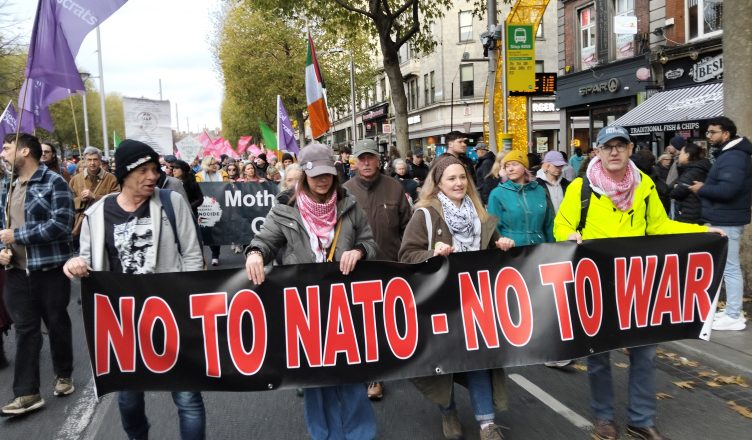
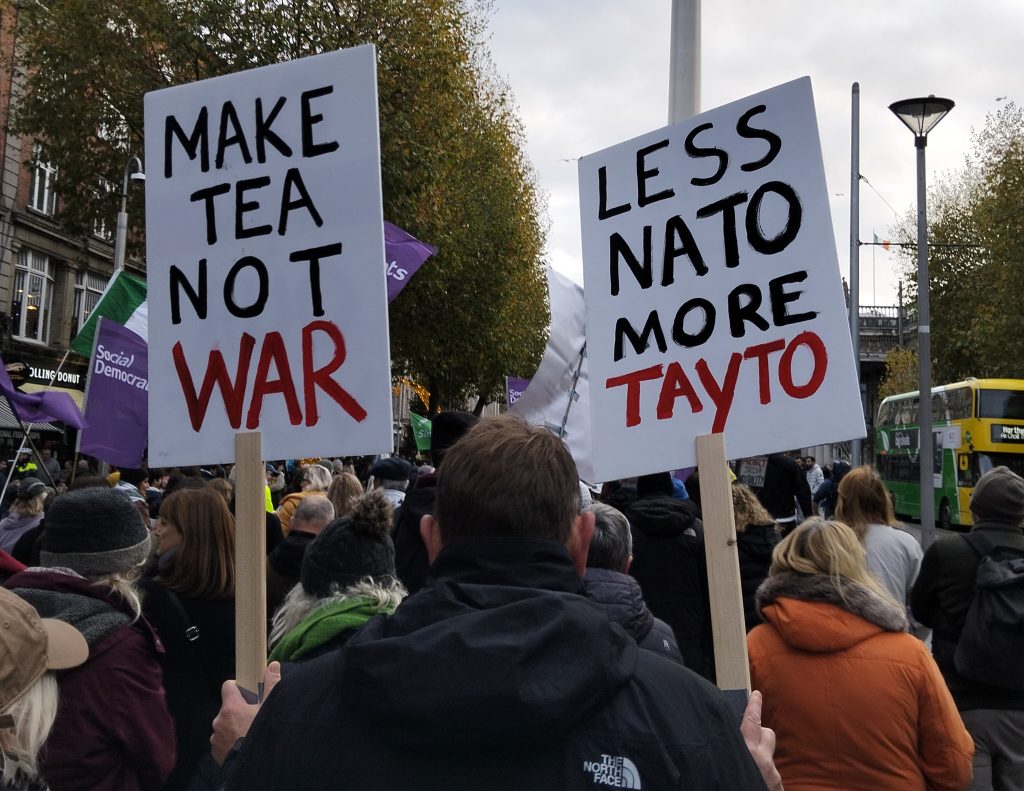
If there is any hope at all, it can be found in the streets. On 21st of November more than 5,000 people took part in a march in central Dublin calling for the retention of the Triple Lock. There were a number of different groups and organisations represented on the demonstration. In addition to the main Dail parties mentioned above, there were NGOs, religious groups, Left-wing parties, pacifists, the old and young and individuals without a particular affiliation.
Anarchists were also part of the demonstration and were able to put forward a perspective that differs from most who took part in the action. Put simply, we do not accept the same organising categories of how the world could and should be. We oppose the nation-state and its mythologies. With the elites of the world engaging in ever more conflicts over land and resources, we reject the spurious category of ‘neutrality’ . We have a side. Our orientation is towards the working people of all places. Those called on to do the fighting and dying for other peoples profits and flags. Our war is the class war.
It is a transnational struggle that needs to be coordinated at the bottom. We recognise that simply taking over the machinery that causes the problems is not going to result in a different outcome. Anarchists work to transcend the current system and to lay the foundations for an alternative based on economic democracy and the ownership and control of the world by those who create the things we truly need.
While those in Ireland who share our exact politics are few in number, there are many who participate in demonstrations, meetings, marches and so on, who are open to the ideas we offer. There are mass strikes and militant demonstrations over a wide number of issues happening across Europe and Asia at the moment. Every effort that points at the undermining of elite myths and offers real alternatives, is an opportunity to spread this militancy.
1 Padraig Og O Ruairc, Burn Them Out: A History of Fascism and the far Right in Ireland (2025) p.p. 172-173
2 https://www.shannonwatch.org/files/docs/ShannonWatch_Book_2015.pdf
3 For background on the Bill check out https://www.trocaire.org/news/what-you-need-to-know-about-the-occupied-territories-bill/
4 https://www.thejournal.ie/funding-eu-ukraine-ireland-military-training-7148911-Sep2026/
5 No To War (PBP Pamphlet) p. 24
6 https://www.zinnedproject.org/materials/you-cant-be-neutral-book/