
“Every time you ask ChatGPT a question, read a Google summary or make an online bank payment, a data centre is working behind the scenes. Now Scotland is part of a global race to build many more of them – on a massive scale. The explosion in artificial intelligence (AI) over the past few years has seen tech firms scrambling to build new “hyperscale” data centres, including some which would rank among the biggest in the world. Plans are in place to build at least 23 giant AI-powered data centres” (https://www.bbc.co.uk/news/articles/c6qxv55882z1o).
AI has insinuated itself into all areas of life and society. For example in education, it has managed to secure huge contracts with universities and schools, leading to the forcing of AI on teachers and students.
AI is controlled by Big Tech capitalists and by heads of state. It hopes to create huge dividends for shareholders and profits for its owners while claiming to be good for society.
AI has not stopped war. It is developing techniques to destroy cities and kill people remotely. It has not created better working conditions, the end of unemployment, and an improvement in living standards. It has done the opposite. It has not led to a solution to climate change. In fact, the mass development of data centres will accelerate climate change. It has not led to social progress. In fact, the plutocrats are increasingly taking over and controlling the media, political and social power and moving towards increasingly more authoritarian forms of rule, in order to preserve and regenerate a failing capitalism.
The uprising against data centres is therefore also a revolt against AI and against a system that puts profits before people and the planet.
Where are the Data Centres
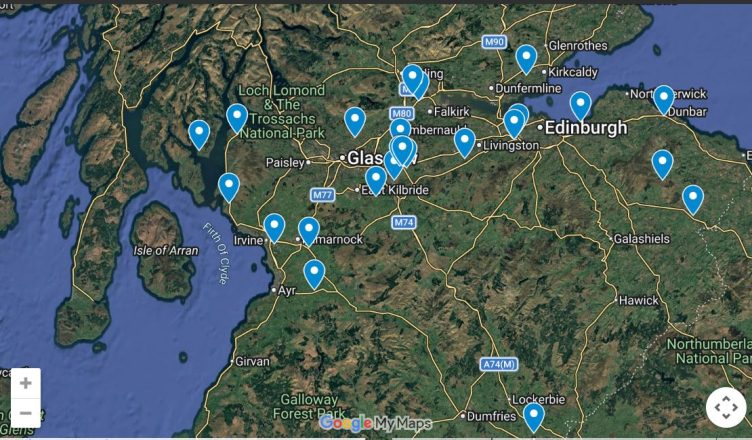
The map, produced by the Action for the Protection of Rural Scotland (APRS), shows the extent of proposed data centres (https://aprs.scot/data-centres-campaign/).
Some of the biggest ones planned are:
Chapel Stile Data Centre (Dumfriesshire)
The Ferret, well-known for its hard-hitting, independent and thoroughly-researched journalism says:
“CX Tech Limited has lodged plans for a 1,000 megawatt (MW) data centre at the site of the former Chapelcross nuclear plant in Dumfriesshire, which could benefit from up to £23m in taxpayer support. Company records show CX Tech’s controlling shareholder is Wpgss Limited, which is owned by property mogul and Tory treasurer Graham Edwards through a holding company registered in the British Virgin Islands (BVI) – a notorious tax and secrecy haven.” (https://www.theferret.scot/scotland-data-centre-graham-edwards/)
Auchertool: Fife
The site would span 60 hectares, about the size of 84 football pitches. It would be bigger than the village itself, completely transforming the life of the village. People are concerned at the noise and pollution, the impact on health and the sheer size of the development. As one villager said: “The village will be left in the shadows of the data centre. It’s huge. It is like having a tower block laid on its side plonked in the middle of the countryside.” (https://www.bbc.co.uk/news/articles/cddle43jr1go)
‘Green’ Data Centres
The applications for the big data centres are claiming to be ‘green’. This way they can be considered to be part of “National Development 12”. It is up to the planning authority to interpret and apply the guidelines. According to Action for the Protection of Rural Scotland: “We believe that there will be serious unintended consequences of this policy until a strict definition of a green data centre is established, combined with an overall limit to the amount of energy that Scotland intends to divert to data centres. We have looked at data centres in development around Scotland and have seen that, in many planning application documents, or pre-application consultations, they are describing themselves as ‘green’ data centres. This can range from claiming to be green because they have solar panels on the roof to claiming the fact they use grid electricity in Scotland makes them green, some mention using waste heat in heat networks.”
The Ferret has found that data centre companies themselves are working closely with government to define ‘green’. “The Ferret has found that in the months leading up to that announcement officials had discussed the definition with Apatura, which is behind more Scottish data centre proposals than any other firm. Correspondence between the company and officials on the issue appears to have started at a networking drinks event at Glasgow’s plush Corinthian Club in April.”
Though the company and the government claim that Apatura’s definition has not been accepted, it is still being circulated among government officials. So far no definition has been forthcoming.
Why Scotland?
Scotland is extremely popular with developers. It has been a target for windfarms because a lot of the landscape it considered ‘empty’ with ‘nothing there’. For those whose aim is to make profits, hills and moors full of wildlife and enjoyed by people for their beauty and solitude, are nothing but places to develop. The Scottish government has also been very supportive of ‘development’. The recent conference stressed ‘growth, drilling, and data centres (https://www.economist.com/britain/2026/10/19/the-scottish-national-party-turns-to-the-right).
From Tom Rampage of the Badenoch and Strathspey Herald, writing about the windfarm proposal to the west of Aviemore:
“Feel free to disagree, but it strikes us as hugely ironic that as we fear the ravaging of our landscape by global warming and assorted climate changes we appear ever keener just to do the job ourselves. There is a kind of petulance in refusing to wait for nature when we have all the weaponry we need here and now.
Having gone to all the trouble of setting up ‘the green belt’, ‘national scenic areas’, ‘sites of special scientific interest’ and the like, we can’t wait to get the diggers into them. Some sceptics believe that all these labels are stuck on our landscape as some sort of road signs for the developers.” (https://www.facebook.com/WindEnergysAbsurd/posts/very-picturesque-isnt-it-no-wonder-that-the-house-has-been-featured-in-film-and-/1532634102227218/)
As a result of windfarms being erected all over Scotland, the country is thought to have a strong renewable energy sector. (This claim is itself dubious as the amount of energy and minerals going in to making and transporting, and then replacing them when they wear out, detracts from the renewable credentials).
But still, accepting that wind turbines are an important part of a climate change strategy, instead of this energy going to help reduce the use of fossil fuels and give communities and local businesses a steady supply of energy, the electricity generated will be used to fuel the data centres, known for their vociferous demand. And, during periods of low wind or when clouds are blocking the sun, it may mean having to fire up fossil fuel power stations to provide the energy required to keep the servers blinking. (https://www.bbc.co.uk/news/articles/c6qxv55882z1o)
Concerns
Many are questioning data centres. According to The Ferret:
“It has been estimated that if all the data centres proposed across Scotland went ahead, they would more than double the country’s demand for electricity. The industry argues they can be powered by Scotland’s growing renewable energy sector, but opponents point out they will need constant power, including when the weather means wind and solar farms are producing less, potentially increasing reliance on fossil fuels. Critics have also raised concerns about the diesel backup generators they have on site and their water requirements for cooling. As a result of these issues any description of data centres as ‘green’ is highly controversial.”
This is in addition to the massive demand for water and the impact they will have on local communities.
Demands and Resistance
Protests against data centres are springing up all over Scotland, as well as in the rest of the UK and other parts of the world. In Scotland, previous protests have demanded a moratorium on new data centres, which the government has now granted until the end of the year. The government claims that it will establish guidelines on environmental impact assessments. However, campaigners do not think this goes far enough. The government has only said that new data centre approval is “unlikely” before the end of the year and there are doubts as to how effective the guidance will be. If data centres are inherently anti-environment (the evidence is already clear), then why go through such a process? It looks as if it will be an attempt at ‘greenwashing’.
Hence a big march called for November 14th in Edinburgh. The march is part of a Europe wide wave of protests to ‘stop dirty data centres’ with other actions in Denmark, the Netherlands, Spain, Ireland and many other countries earlier in the month. The Edinburgh protest will also coincide with a global day of action around the UN climate talks COP31 in Antalya, Turkey.
According to the organisers (https://foe.scot/press-release/thousands-expected-to-join-march-against-ai-data-centres-in-edinburgh/)
“We will be marching to demand that the people of Scotland can have their say on these monstrous AI data centres. Big Tech billionaires have set their sights on Scotland as their next AI data centre hotspot but we still have time to stop them.
“The huge data centres being proposed would crowd out communities, double Scotland’s electricity demand and make our energy bills more expensive, as well as destroying our natural environment and using thousands of tonnes of critical minerals.
“We need a public conversation about the need for AI and monster data centres. The Scottish Government should be led by what the people of Scotland think about these proposals, and not the profits of big tech developers. That’s why we’re marching to demand a proper public consultation on these AI data centre plans before any decisions to build them are made.”
Supporters say:
“We’re parents, neighbours and ordinary people who care about where we live and the future of Scotland. What started as a local fight for us in West Edinburgh has become a nationwide movement against US tech billionaires. We cannot allow them to dictate the future of our countryside and our communities, they do not bring the benefits that many developers, tech firms and Donald Trump would lead us to believe. We are asking the Scottish Government to stand shoulder to shoulder with us and not let this happen. Big tech, go hame tae think again!”
Sarah Finlay, a community campaigner with West Edinburgh Against AI Data Centres
“We are marching to say that we don’t want AI data centres in Scotland. The Annan and wider Dumfries and Galloway communities have let it be known that we do not want a data centre here or anywhere else. We are calling on the Scottish Government to call in the Chapelcross data centre application, and to press the brakes on AI data centre developments across the country. The risks of these developments are numerous and serious. The health and voices of our communities matter.”
Sam Gibson, a Dumfries and Galloway resident who is campaigning against the Chapelcross AI data centre
For more information see:
https://www.globaljustice.org.uk/event/stop-ai-data-centres-scotland-march/
Conclusion
It is great to see an anti-data centre movement developing. However, it needs to go much further than call for a moratorium on hyper data centres because it limits the scope of the campaigns. We know that capitalists are very experienced at getting around objections to planning applications by putting in more than they want, and then appearing to compromise. This could be the number and height of wind turbines, the height of tall buildings in urban areas, or the size of data centres. They will also use bribes to the local community to get their way. Making the government back down in the face of powerful Big Tech will not be easy and will take more than demos. A militant mass movement is required, one that is willing to get to the very heart of the problem- capitalism.