
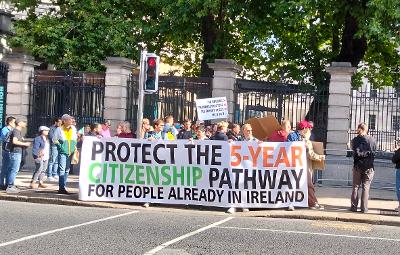
The coalition government in the south of Ireland is proposing to change the rules surrounding citizenship. At the moment it takes 5 years to become a naturalised citizen. The intention of Minister for Justice, Home Affairs and Migration James O’Callaghan, is that it will require 8 years. In addition, you can’t have had welfare payments in the last 2 years of that period. Plus you need to show you have a certain level of ability in Irish or English. Let’s look at what is driving these revisions.
The change seems to come out of nowhere. One of O’Callaghan’s explicitly declared reasons for the modification of the law is a technical one. He says that Ireland is an outlier in European Union (EU) terms and should be brought into line with EU norms. He cited Germany as an example of a country that requires an 8 year wait. The trouble is, this is just factually not true. Germany actually reduced its requirements from 8 to 5 years in 2024 (https://www.bmi.bund.de/SharedDocs/kurzmeldungen/EN/2024/06/mod-staatsangehoerigkeitsrecht.html).
In reality, there are a variety of conditions across the EU. Twelve of the 27 member states have a standard residence requirement of five years for naturalisation, according to a report published in 2025 by the Robert Schuman Centre for Advanced Studies (https://globalcit.eu/new-globalcit-study-compares-conditions-for-citizenship-acquisition-by-immigrants-and-their-descendants/).
Another argument employed was that the changes “…seek to ensure that citizenship reflects a demonstrated, durable connection to Ireland, knowledge of the state and its institutions, and a sustained commitment to participation in Irish society” (Dublin People, 7/10/26). Even if you accepted the desirability of these qualities, how can such vague and subjective things be adequately measured? We are expected to believe that 5 years would not prove a durable connection or a commitment to participation in “Irish society” but 8 years has magically achieved that? It is really just an arbitrary number.
There is clearly more at work behind the scenes. One possible reason for the adjustment is the current Taoiseach/Leader of the Government Michael Martin is seen as vulnerable on his Right flank and O’Callaghan senses an opportunity to look tough as part of a future bid to depose him. So in that aspect, socially vulnerable sectors of society are being used as pawns in an elite power game.
Besides the personally ambitious dimension, there’s also the ideological one of using immigrants as a red herring or scapegoat for failures of the system. By putting pressure on relative newcomers, longer term residents and those born on the island are expected to divert attention towards those supposedly less worthy than themselves. It’s not big business, landlords and their friends in government who are to blame for the housing crisis, energy prices or the general cost of living. It’s Maria the cleaner and Pedro the kitchen hand who have been in Ireland ‘too long’ and need to be discouraged from staying. In other words, classic divide-and-rule.
The new amendments clearly have a class element to them. Imagine you have saved some money and decide to embark on a long journey to start a new life. You secure a job undertaking physical labour, probably one not many of the locals want to do. You work hard for 5 or 6 years. Then you have an accident or develop a disability. Or maybe you lose the job because a tanker is bottle-necked in a canal overseas or a madman running a rogue state starts a war against a small oil rich nation causing delays in supply lines, an increase in prices and lay offs. Or perhaps AI and the development of robots means employers are less reliant on human labour. Any number of reasons beyond your control could cause you difficulty. You’ve paid taxes. You apply for welfare support. Great, don’t expect citizenship now. It’s your own fault, you foreign parasite.
A common phenomenon is one where as an immigrant you take a job that makes it difficult for you socially. Its not uncommon to have a graveyard shift working alone or with fellow immigrants. Likewise you might have to live with people from a similar background. That’s either due to discrimination or lack of finances to take up other options. In reality, due to the cost of living you may actually have to take-on another job as well, just to get ahead. Somehow in such a schedule you have to find time for sleep and to become highly articulate in another language. Even if you can spare an hour to study, who will pay for quality lessons? Well, that’s up to you.
In case the above seems too anecdotal, there are specific categories of people who are already in the firing line due to the changes. Ukrainians who have been in Ireland due to the full scale invasion of the country in 2022 and are covered by the Temporary Protection Directive, will not be allowed to put the time they’ve already spent on the island towards a citizenship application. Another case concerns over a hundred Palestinian students who have had their application for university places denied and will not be permitted to have their cases reviewed. So, with people from war-torn regions getting treated like disposable items, the conditions for others are likely to get harder too.
There are clearly tough times ahead in Ireland. It’s possible some as yet unforseen counter-measure may negate or cancel the government’s new moves. It seems unlikely. Even if O’Callaghan and his faction no longer continue to have the upper hand in implementing more severe measures, this stuff is not just the vanity project of an individual leader-manque. The macro-level landscape is one dominated by capitalism and the nation-state as organising actors. This is based on imaginary boundaries, of in/out dichotomies, extreme hierarchies and private or state ownership and control of resources in a particular geographical area.This combination results in the harsh absurdities ordinary working people suffer from.
Given the arbitrary nature of the system, its tempting to make moral or rational arguments that oppose the basis and method by which citizenship is or isn’t granted.Take for example the way the island was partitioned in the 1920s’ along (literally) lines that were not favoured by the majority and still aren’t. Perhaps such facts could be used to as a starting point for a discussion on the wider question of the nation-state.
Likewise, statistical material showing the economic reliance the system has upon those not born on the island, can be useful. For example, the OECD International Migration Outlook 2025 highlights that 43% of Doctors in Ireland qualified elsewhere, compared with an OECD average of 20% and 52% of nurses, more than anywhere else they surveyed (https://www.oecd.org/en/publications/international-migration-outlook-2025_ae26c893-en/full-report/international-migration-of-health-professionals-to-oecd-countries_fea88ae4.html).). It’s true in this case the numbers include a few born in Ireland who may have studied elsewhere. However, that just shows the relative generosity of those places.
Taking another crucial sector, approximately 25% of workers in the construction industry are not considered Irish according to the Central Office of Statistics (CSO) (https://www.cso.ie/en/releasesandpublications/ep/p-biilmss/businessinireland2025-labourmarketandsocialsustainability/laboursupply/). One of the most notable areas where non-Irish workers contribute is in hospitality, restaurants and hotels. According to the CSO, they comprise 46% of the workforce (https://www.cso.ie/en/releasesandpublications/ep/p-eaads/earningsanalysisusingadministrativedatasources2025/nationality/).
So even a cursory look at the economy reveals meaningful contributions to society as a whole by incoming workers. Of course, not everybody is statistically inclined or will be convinced by any amount of numbers you chuck at them. Its certainly not being suggested here that those running things at the top will change course significantly, once they know these facts. They already know them.
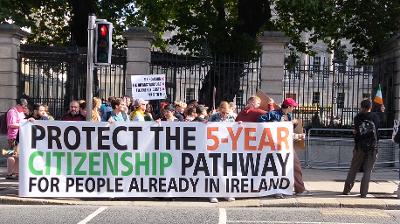
Having moral, historical, logical and statistical arguments can form an element of whats required to oppose the naturalisation changes. However, that’s not enough unless there’s also practical organising on our streets, in workplaces and neighbourhoods. There have already been some small, poorly attended street demonstrations in Dublin, for example. It’s a start, but a lot more needs to be done.
The task ahead is to forge links between all workers, regardless of origin and nationality. Building networks that transcend differences of language, birth, age, ability etc and focusing on our common condition as participants in an economic and political arrangement that is kicking us all. This could involve existing organisations when and where they are useful, or more likely, building them from scratch. It won’t be easy but as citizens of the world, its something we have to attempt. As the Nineteenth Century Irish radical James Fintan Lalor put it -“ Remember this-that somewhere and somehow, and by somebody, a beginning must be made”.
B.