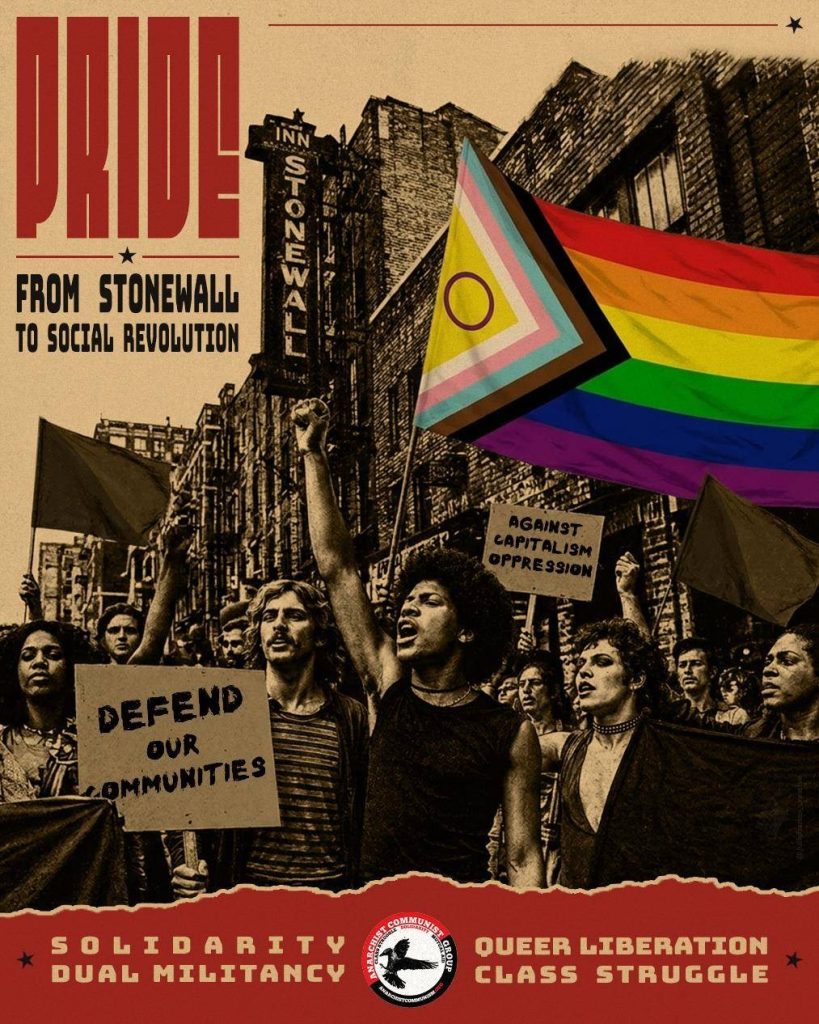
Every June, politicians, corporations and state institutions wrap themselves in rainbow colours and speak of diversity and inclusion. Yet the history of Pride did not begin in boardrooms or parliament. It began in resistance.
The Stonewall uprising of June 1969 was not a peaceful appeal for equal treatment but a collective revolt against police harassment and state violence. Trans people, drag queens, queer youth, sex workers and other marginalised members of the working class fought back after years of repression. Pride was born as an act of rebellion.
More than fifty years later, many of the conditions that gave rise to Stonewall remain. LGBTQ+ people continue to face discrimination, homelessness, insecure work, violence and unequal access to healthcare. These attacks do not affect everyone equally. Working class queer people are hit hardest because oppression and class exploitation reinforce one another.
This is no accident. Capitalism relies on systems of patriarchy and gender oppression to maintain the family as the primary unit for reproducing labour power and caring for workers at little or no cost to employers or the state. Institutions such as the police, the courts and the education system have historically enforced these social norms while suppressing those who challenge them.
Today, corporations market themselves with rainbow logos while exploiting workers. Governments celebrate Pride while expanding policing, attacking migrants, restricting trans rights and supporting wars abroad. Symbolic representation cannot compensate for material oppression.
For anarchist communists, queer liberation cannot be separated from the struggle against capitalism, patriarchy and the state. We reject both conservative attacks on LGBTQ+ people and the illusion that liberation can be achieved through corporate sponsorship or parliamentary reform alone.
The legacy of Stonewall reminds us that progress has never been handed down from above. It has been won through collective struggle, direct action and solidarity.
Pride is not a brand. It is the memory of resistance, the organisation of our class and the continuing fight for a free society without oppression.