
November and December saw a series of general strikes throughout Europe, in Italy, Belgium, and Portugal.
Belgium
In Belgium, there was a national public transport strike on November 24th, the following day a public sector strike, involving administration, health services, the post and education, and on November 26th a massive general strike. Both airports at Brussels and Liège were shut down, as was the Volvo factory at Ghent. These strikes are in response to the austerity measures by the governing right-wing New Flemish Alliance (NVA), led by Bart de Wever, which threatens pension cuts, the end of a wages index on inflation, and the cutting of benefits including unemployment insurance. At the same time the NVA spent €1 billion on providing arms to Ukraine and raising military spending by €4 billion.
The strike was successful throughout the three regions of Belgium- Flanders, Wallonia, and Brussels, and was the biggest strike action in 40 years.
Italy
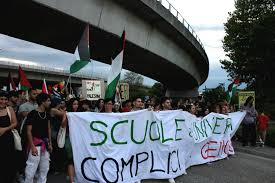
The Italian base unions, those controlled by the rank and file, Unione Sindacale di Base (USB, Union of Base Unions) and the Confederazione Unitaria di Base (CUB, United Confederation of the Base), Confederazione dei Comitati di Base (COBAS,Confederation of Base Committees) and Sindacato Generale di Base (SGB- General Union of the Base) went out on strike on November 28th. Tens of thousands came out on strike, involving workers in health services, rducation, transport and administration, with a 24 hour rail strike and the cancellation of 26 flights. However, the mainstream union, the General Confederation of Italian Labor (CGIL), refused to join in this action, choosing instead to strike on December 12th bringing out a half million workers. This was an outright act of sabotage against working class unity.There were 50 demonstrations throughout Italy, with a turnout of 100,000 on the one in Florence. Again , these strikes were in opposition to austerity measures brought in by the far-right government led by Giorgia Meloni, as well as her plans to raise military spending to 5% of Gross Domestic Product.
Portugal
In Portugal, a nationwide strike took place on December 11th against the decision by the right-wing government of Luis Montenegro and his Democratic Alliance (AD), supported by the far right party Chiega, to scrap laws protecting workers from redundancies, maternity benefits, the opening of increased control by the bosses over work hours and outsourcing, It includes easier dismissals, expanded employer control over working hours and outsourcing, weakened collective bargaining, and attacks on maternity protections. These moves will attack what was left of the measures introduced during the 1974 Revolution in Portugal. The government also seeks to broaden minimum service obligations during strikes, extending them to more sectors and further limiting their impact. At the same time the Montenegro regime is increasing military spending by €1 billion.
The general strike was massive, involving three million workers and closing down the railways and the metro in Lisbon. There was widespread strike action in the health services, in schools, among municipal and postal workers, and in administration. Rubbish collections were massively halted, and sanitation and water treatment was drastically effected.
There was widespread disruption at the airports, whilst all 17 major fishing ports were shut down. An important factor in the strike was the significant number of private sector workers who took part. This effected insurance, banking, communications, and the cultural sector, as well as logistics, with lorry drivers joining in. The big Volkswagen plant also suffered severe disruption.
In Parliament Square in Lisbon cops fired rubber bullets at demonstrators and arrested six.
These strikes show the increasing anger of the working class in Europe, in response to the austerity measures and increased military spending. Coupled with the Block Everything actions in France on September 10th and a million strong strike there the following week, the strike and occupations in Italy on September 22nd, and the continuing unrest in Serbia and Croatia, as well as the Z Generation uprisings in Nepal, Indonesia and Madagascar, this shows that resistance is growing to the plans of the boss class internationally, with their corruption, swingeing austerity measures, and increased militarisation.
Resistance is Fertile!
P.S. Greek railworkers came out on a 24 hour strike on November 18th. This was in response to layoffs over recent years, bullying behaviour by management, delays on routes, lack of maintenance, staff shortages and poor working conditions. The strike was effective on both national and suburban lines.
Workers demand full staffing and direct recruitment, repairs and modernisation of equipment and engine rooms, action to reduce delays, job protection, reinstatement of sacked workers, and improved hygiene at stations.