
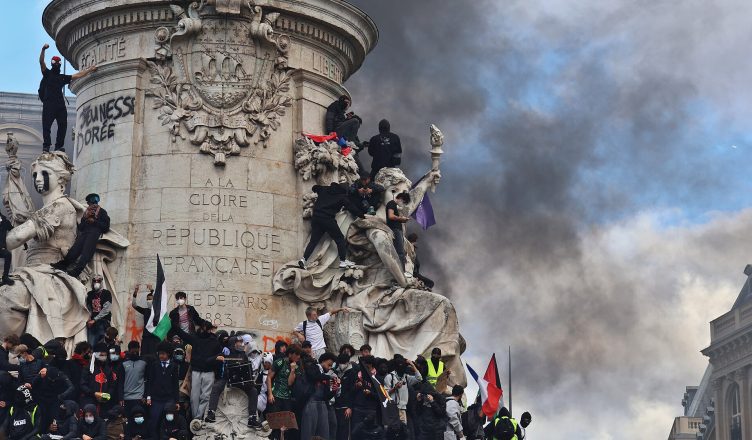
“If high school and university students are accused of violence today, it is merely a smokescreen. The real violence, the only violence, is still and always on the side of governments, capitalist policies, and the State that wants to save money at the expense of our lives and the future of our youth.
They are rising up for better living and educational conditions. They are rising up for all of us. They are rising up for their parents. They are rising up for those who work and are exploited. It rises up against the true and only violence that exists: that of the authorities announcing a new austerity program of 54 billion euros, cuts to public services, education, hospitals, and social security.”
From a statement of the Fédération Anarchiste of France.
“The government, overwhelmed, no longer knows what tactic to use to divide the current social movement, between the “good ” peaceful protesters and the “bad” vandals and looters. We reject this division and advocate for a diversity of tactics; our solidarity goes to the victims of repression and state violence. While a protester has died in Paris, we strongly reject the indecent injunction to “condemn the violence” of the social movement. The society of precarity, racism, and war that the government has forged with the bourgeoisie can only sow misery and generate anger. Widespread social inequalities lead to the direct socialization of goods that are becoming increasingly inaccessible. We will only have what we take.”
From a statement from the Union Communiste Libertaire.
In France, in Belgium, in Portugal and Spain, in Italy, in Greece, in Albania and Argentina, we have seen mass mobilisations, confrontations with the police attack dogs, blockades of roads and ports, strikes and State buildings attacked. This reflects a growing anger throughout the working class internationally against austerity programmes, rising food and energy prices, rising rents and lack of housing and worsening conditions.
Alongside this is disquiet about the worsening climate crisis, increasing State control, surveillance and repression, and the drive to war.
In France on October 17th, 1 million people mobilised against the rising cost of living. There were included 100,000 in Bordeaux, 80,000 in Toulouse, 60,000 in Nantes, 60,000 in Lille, 50,000 in Lyon, 40,000 in Montpellier, 30,000 in Strasbourg, 30,000 in Grenoble, 20,000 in Rennes, and 20,000 in Rouen. There were vast numbers in Paris, Marseille, and other cities where the police attacked demonstrations very early. In Marseille, students, workers and supporters of the Yellow Vests set up barricades. City Hall and a police station were attacked, as well as several large chain stores.
There were attacks on government buildings and blockades of highways and train stations. The police response was vicious. One paramedic died in Paris after being beaten by the cops. A 17-year-old girl lost her eye after being hit by a tear gas canister, and hundreds of others have been injured with more than 2,400 arrests.
This is in the context of the ongoing movement of high school students, now joined by university students. The uprising in France appears to have acted as a spark to ignite social conflagrations in other countries.
In Italy, on the 16th October, more than 400,000 students took to the streets in over 40 Italian cities for the “No Meloni Day” protests, demonstrating against the high cost of living and the racist and militaristic policies of Giorgia Meloni’s right-wing government. In Rome, students targeted the Ministry of Education building, which was heavily guarded by riot police. In Bologna, clashes with the police broke out in front of the city’s central train station. In Turin, clashes with police occurred when students attempted to approach the Prefecture.
Across the country, dozens of schools and universities have been occupied by students, who reported intimidation by police forces—including nighttime searches of their homes, arrests, and requirements to report regularly to police stations. A general strike was called for the following day, with a national demonstration in Rome.
Thousands took to the streets on the 17th against austerity measures, in particular the cutting of education funding in favour of military spending, and against the rising cost of livings. There were clashes with the police in Milan, Turin, Bolognia and Brescia. There were many arrests.
Another general strike has been scheduled for October 30 by grassroots unions and various social organisations.
In Portugal, inspired by France and by the massive movement in Spain over the housing crisis, protest camps were set up in the city of Porto, in response to the government’s new policies that favour landlords and make evictions easier. From the start, these encampments have been under police attack. Many have been injured by the cops. In Lisbon and other cities, thousands came out on the streets. In Lisbon, the group “Não dá mais para viver assim” (We can’t go on living like this) headed up a demonstration of thousands against the rising cost of living, unaffordable housing and wages not able to even fulfil basic needs. There was a similar demonstration in Coimbra.
For many young people “working hard” is no longer enough to secure a decent home. On average, Portuguese people can only afford to leave their parents’ home at age 29. Portugal’s national minimum wage has been reported at around €820 a month after tax, while renting a one-bedroom flat in Porto can cost up to €1,215 a month. Rents have risen by more than 100 percent over the past decade.
In Belgium, protests by high school students began on October 1st, ignited by the French events. Demonstrations in Brussels and Liege against cuts in education funding and budget cuts began, with police repeatedly attacking with water cannon and tear gas canisters. There were many arrests, and barricades were thrown up to protect against the police attacks.
In Liege, the motorway was blockaded, and again barricades were built.
Belgian Interior Minister Bernard Quintin said in a post on X/Twitter that “what is unfolding in Brussels is no longer mere protest” and “all necessary means will be used to restore order in the face of the rioters.” The government moved to ban demonstrations.
Further afield, in Colombia, in South America, a major strike began on the 14th October against the neoliberal policies of President Abelardo de la Espriella. Tens of thousands of people took to the streets in Colombia’s major cities to protest against a new decree that criminalises social protest, and to demand improvements to working conditions and the education system. The mobilizations come one day after the entry into force of Decree 1525, which “defines the new protocol for how authorities should act during public demonstrations” and legitimises the use of force by the police at such events.
There were attacks by the police on demonstrations in Medellin, Cali, Ibagué and Bucaramanga. In Popayán, protesters attacked the offices of the governor and the mayor. Police used tear gas to disperse the demonstrators.
In Mexico, the police attacked a demonstration over contaminated drinking water that had flooded many homes on 12th October. When the demonstration arrived at the official residence of the governor of Jalisco state, in Guadalajara, they were attacked by cops, who arrested 39 people.
In Chile, on 12th October, on the National Day of Resistance of the Peoples, various indigenous and social organisations took to the streets to demand protection, autonomy, and an end to the militarization of indigenous territories, as well as the release of Mapuche political prisoners.
Riot police repeatedly used tear gas in an attempt to split the march in two and arrested 17 people.
Not Just the Youth
It should be remembered that it is not just youth, and in particular high school students, involved in mobilisations. In France there was a national mobilisation in support of the public services that was initiated by the firefighters. The high school students threw their support behind this. In addition, university students have also come out in support of the demands of the high school students. Education workers and other workers have also given their support to the mobilisations, in some instances going out on strike in support.
Whose Violence?
At least 170 students have been seriously injured by the cops. One student lost the use of his right eye; one paramedic died in Paris after being beaten by the cops. A 17-year-old girl lost her eye after being hit by a tear gas canister. Another lost his teeth and suffered a double fracture to the jaw after being hit by a rubber bullet. One cop arrested a high school student and held his head under water. Many were throttled, some into unconsciousness. One student lost a hand, another an arm. Demonstrations were consistently targeted by the cops, who used violent measures like tear gas, pepper sprays, rubber bullets, water cannon and baton charges. The violence we see comes from the State, whilst anyone who fights back against this is seen as a violent thug.
Despite this brutality, the movement grows. The deployment of 70,000 tooled up cops failed to deter the massive demonstrations on October 24th. Hundreds of thousands in Paris, tens of thousands of people in Marseille, 20,000 in Lyon, 10,000 in Bordeaux, and at least 30,000 people in Orléans.
This movement in Europe and further afield, is the biggest since 1968. However, as yet workers have not come out in significant strikes and occupations as happened then. The developing movement must link up to the dockers’ international actions against war and militarism on October 30th. The decision by the different trade union centrals in France to call a one-day general strike on November 5th must lead to workers attempting to extend strike action beyond just one day to an indefinite general strike and to workplace occupations. The union bureaucrats are calling the November 5th strike to try and tame the movement. They have consistently acted against unity between students and workers, marching union contingents off separately from those of the students on demonstrations.
President Macron of France, has condemned “unbridled” violence, not that of his vicious police thugs, but the defensive actions of demonstrators, and blamed hooligans, criminals and the “ultra-left”. It is hardly surprising that the far-right National Rally, led by Marine Le Pen, endorsed this. Andy Burnham’s government has stated that the violence in France is “unacceptable”, not referring to the State violence. Burnham and co. are worried that the unrest in continental Europe will spread to the UK.
If that happened, the Burnham regime would use exactly the same tactics used by governments in the rest of Europe.