
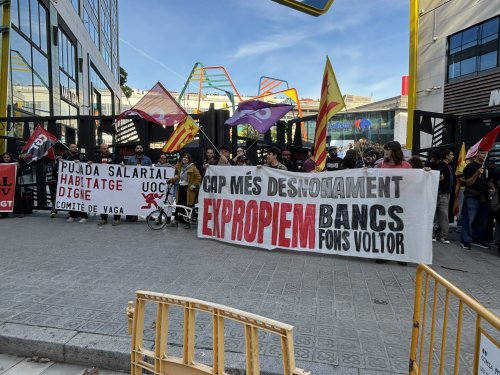
The 24-hour general strike that took place on Wednesday, November 11th, involving around 4 million people, had its origins in the big protests in October against the housing policies of the Socialist Party (PSOE) government, led by Pedro Sanchez, in alliance with the left Movimiento Sumar, especially against the eviction of 87-year-old Maricarmen Abascal which eventually led to her death. Rents have risen by 45% and house prices by 68%. Between 2008 and 2015 there were 500,000 evictions. These protests themselves involved millions turning out in many parts of Spain.
Sanchez responded by dissolving his government and calling for snap elections on November 29th. He hoped to blackmail the movement by offering a false alternative of supporting the PSOE government, or opening the way to a government of the Popular Party-PP (with its roots in Francoism) and the fascist Vox party.
A movement towards organising a general strike began with the housing movement, especially around the Sindicato de Inquilinas e Inquilinos (Tenants Union) of Madrid, spreading to Catalonia. It coordinated with the syndicalist and anarcho-syndicalist unions CGT and CNT (100,000 members and 15,000 members respectively. These jointly organised neighbourhood strike committees, which ensured massive strike pickets on the day.
The leadership of the union centrals UGT, controlled by the PSOE, and in alliance with Sumar, and the CCOO, controlled by the Stalinists, then were forced to swing in behind the strike call, hoping to gain control of the movement.
This is in the context not just of the housing crisis, but of wages remaining stagnant, and rising inflation. The cost of living has shot up considerably, by at least 45%, with big food, and energy increases. In the meantime, corporate profits have risen 40%.
Sanchez used the vote in Congress (Parliament), where a Housing Decree, reforms announced to head off the housing movement, was blocked by the PP, Vox, and the Catalan right-wing party Junts. The PSOE was re-elected in 2023, on a promise to halt the housing crisis. A huge building boom led to a slump, but instead of socialising the huge number of empty houses, the PSOE government sold them cheaply to investment bankers. Promised rent controls and increases in social housing were not enacted, whilst tax breaks were given to the big landlords.
The Sanchez government and its allies in the UGT and CCOO leadership hoped to use the mobilisation to stay in power. However, the four million who turned out on the day, are acting against the policies of the PSOE-Sumar government, disgusted by both the crises in housing and the cost of living. On the day, the various unions influenced by anarchism and anarcho-syndicalism mobilised their members, as did the many neighbourhood housing action committees, which have a membership of 10,000.
Despite the bad weather in some regions, there were massive demonstrations and large blockades in many towns and cities. The biggest was in Madrid, despite teeming rain, followed by that in Barcelona. The strike began at midnight. Blockades were put up on major highways, and large workplaces were picketed. Strikes heavily impacted industries in Madrid, Catalonia, Valencia, and the Basque country, and less so in other cities and provinces.
The railways were completely closed down, with a strike beginning the day before. Big chain stores were picketed and shut down, including supermarkets like Mercadona, Adidas, Benetton, El Cortes Ingles and Zara.
Of course, the forces of the State intervened, with the cops attacking demonstrations and making at least 115 arrests.
On the day after the mobilisation, Sanchez introduced another two decrees that were almost identical to the rejected ones. They were presented to a smaller parliamentary council on Thursday, giving the government a better chance of passing the laws. The first decree passed narrowly and includes a measure extending protections against evictions for tenants deemed by social services to be in a precarious financial or social position, as long as regional authorities cannot offer them an alternative residence. Another measure attempted to reduce real estate speculation by stopping any company involved in the real estate market from buying properties for less than 70 percent of their value.
However, it was rejected. again narrowly, after the centre-right Basque party voted with the right-wing bloc after having supported the other decree. The PP and Vox pledged to repeal these reforms if they come to power on November 29th. These reforms have only limited effect, as the central government has no direct power over the regional autonomous governments on housing policies, which control regulation and planning, public housing and rental markets.
The November 11th general strike was massive. But one day is not enough. Already there is an awareness that further future mobilisations are needed, and further protests are being planned by the housing unions, the CGT, CNT, the assembly’s union Intersindical Alternativa de Catalunya (IAC), and the Basque unions, ELA and LAB, to pressurise the big landlords and the regional governments.
The Spanish working class is increasingly disenchanted with the ploys of the PSOE government and its left allies, whilst rejecting the PP and Vox. It must now look urgently to creating its own autonomous organisations in both workplace and neighbourhood, independent of the political parties and looking towards building its own strength, and in the long term, looking towards the coming about of libertarian communism, postponed in 1937.