
The recent Budget told us which priorities Labour were setting. Billions for war, and slashing funding in other areas of spending. Arms manufacturers will receive greater government backing, and the development and manufacture of military technology will be a growing part of industrial strategy.
Chancellor Healey will be spending “£10bn of additional economic and military support—based on loans, Export Finance guarantees, and half a billion in urgent military funding for this winter.”. This is in addition to the £25 billion already put into defence by previous Tory and Labour governments. As the Budget pledged, “the government’s fully funded Defence Investment Plan will deliver stronger front-line military capability, supporting jobs, businesses and economic growth across the UK.” There will be £5 billion for advanced uncrewed systems for the rest of this Parliament, up to 2030. This includes £300 million for the StormFighter combat-air programme and £400 million for Army drone technology.
All this will mean an additional £15 billion annually on the military (rising to £36 billion a year if long term targets are met).
One of the events that triggered Starmer’s leaving of the scene, was the resignation of Healey as defence secretary. He left because he felt that defence spending fell“well short of what is required for defence and the country at this dangerous time”. He talked about the invasion of Ukraine and the Russian threat, and talked about a Russian attack predicted by NATO by 2030. Now, three weeks after his initial resignation, Healey is Chancellor, and imposing his defence plans.
The government has re-affirmed its obligations to NATO to spend 3% of GDP by 2030, and 3.5% by 2035, the details of which will not be published until the 2027 spending review. In addition, the National Wealth Fund and British Business Bank will put up to £5 billion over four years into defence, dual-use technologies and related national security sectors. The Innovative Defence Financing Taskforce has been established to seek additional private and international capital.
In order to pay for all this defence spending, this would be done by slashing the budgets of other departments by 1% from 2027‑28 to 2029‑30 to raise £3 billion, with £1.7 billion from the Treasury’s capital reserve. One of the projects that will suffer is the Warm Homes Plan, which will get a cut of £1 billion. This comes at a time when many are facing higher energy bills. As was noted in the Budget statement, “… it is not necessarily the case that all departments will see real-terms increases at the next spending review”
The money is hard to find. Labour is too timid to put taxes on the rich. Already, thanks to years of austerity cuts from both Tories and Labour there is very little to spend. So what Labour will do, is attack benefits. In fact, Healey told the House of Commons after the Budget that “There will be a reduction in the benefits bill.”
This can be seen with the recent review entitled “Young People and Work” headed up by Alan Milburn, a Blairite Labour MP. This threatens the taking away of sickness and disability benefits for under-25s. They would be barred from claiming Universal Credit or the Personal Independence Payment (PIP), the main disability benefit, and instead receive a new youth allowance.
Milburn supports schemes like Sainsbury’s Modern Work Experience Programme, also endorsed by Burnham, where the supermarket chain would use 10,000 young people as unpaid labour.
Any under-25s who fail to engage with the scheme proposed by Milburn would risk losing part of the allowance. He received the full support of Andy Burnham on this, who is open about increasing military spending, paid for by cutting benefits.
Another ominous move by Labour is the forthcoming review of disability benefits by the disability minister, Stephen Timms, another Blairite, indicating further welfare benefit cuts.
This upping of military spending and cutting of welfare spending has been prepared for by the right- wing press and think tanks. The notorious Paul Johnson called for Burnham to cut PIP, whilst talk about abolishing the triple lock on state pensions is rife in right wing rags. Alongside this is rabid propagandising for increased military spending from the likes of the Daily Mail and the Daily Telegraph. In addition, the sick, the disabled and the young are increasingly targeted as scroungers.
Recently, the right-wing think tank Centre for Social Justice (CSJ), which was founded by former Tory leader Iain Duncan Smith, published State of Dependency, arguing that the benefits system was dragging the UK down, and stating, among much else, that the “increase in welfare spending this year alone is equivalent to 15 advanced Royal Navy frigates, 220 fighter jets, or 250,000 soldiers’ salaries, more than three times the size of the regular British Army.” The CSJ clearly makes a distinction between “deserving” and “undeserving” poor, talking about “medicalised worklessness”, and clearly aiming at abolishing PIP.
For her part, the Tory leader Kemi Badenoch whined that the extra spending needed to reach the pledged 3 percent of GDP on military spending by 2030 was “less than a third of the increase in welfare since Labour came to office.”
The UK Strategic Defence Review of 2025, penned by NATO supporters and partisans of Trump, sketched a scenario where one of its contributors, Fiona Hill, said that “we’re already in a situation where you could describe this as World War III structurally”, a ludicrous statement bearing in mind Russia’s inability to gain victory over Ukraine. This has fed Healey’s talk about a Russian attack in 2030.
Hill went on to talk in the Guardian about the UK needing a “different mindset”, involving greater internal cohesion, in other words, total class peace and class collaboration. The Strategic Defence Review advocated a public outreach campaign with the Department for Education developing “understanding of the armed forces among young people” and an expansion of cadet forces in schools and communities. ‘Anchor partnerships’ must be built with “a small set of trusted universities” to develop military science and technology. To reverse the decline in forces numbers from a Cold War peak of 311,000 regular personnel – with the army today, at 73,790, its smallest since 1714 and facing “a longstanding recruitment and retention crisis” – the review talks hopefully of “a national conversation led by the government” that maybe could “reconnect defence with society”.
Last month Burnham promised every young person a “high-quality technical pathway, work placements, apprenticeships and the skills and experience they need to secure a good job,” with “timely, high-quality mental health support”. This is offered in place of a university education that tuition fees and the rising cost of living are putting ever further out of reach, leaving it increasingly a route open only to the children of the wealthy.
Who gains most from all of this? The UK arms industry. BAE Systems, Britain’s largest defence contractor, saw its shares rise by 7.81% over the previous five days before the Budget, reaching £20.85 by late morning on 29th October 2026. It is the arms manufacturers who profit greatly from the current war fever.
All of this is not just a British phenomenon. Germany is looking towards increasing its military spending whilst cutting benefits, and there is a similar situation in France. Pay, pensions, and public services are also under attack at the expense of defence spending. Whilst the protests shaking Europe do not address this as a central concern, it is increasingly being brought to the attention of those involved in these movements.
We do not think that a Labour government with a “left” agenda would be any different. We have seen Corbyn’s capitulation to NATO when he was Labour leader. Corbyn has a long record of supporting anti-militarist and nuclear disarmament initiatives. The Manifesto produced by Labour at the time stated that a “Labour government will undertake a Strategic Defence and Security Review to assess the security challenges facing Britain, including new forms of hybrid, cyber and remote warfare.” It said that at least 2% of Gross Domestic Product would be spent on defence and that Labour would contribute £100 million to UN operations.
Having a ‘better’ leader, a more ‘radical’ programme, or more favourable circumstances will not make any difference next time. The ruling class will do everything in its power to ensure that the rule of capital continues on their terms.
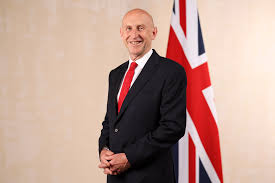
Picture: Lauren Hurley, Creative Commons.