
From a correspondent in the Republic of Ireland.
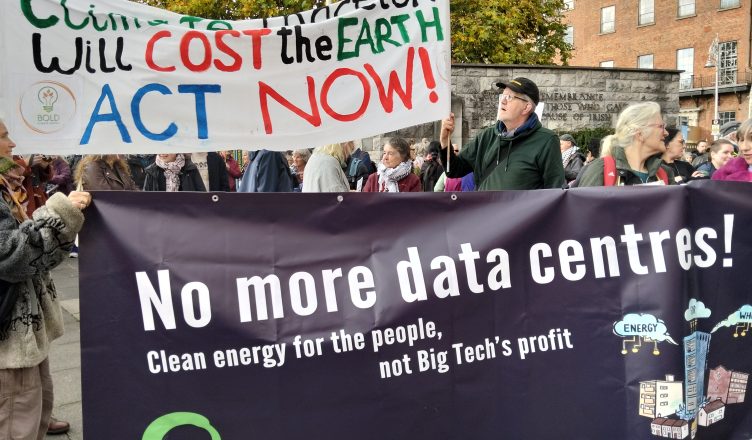
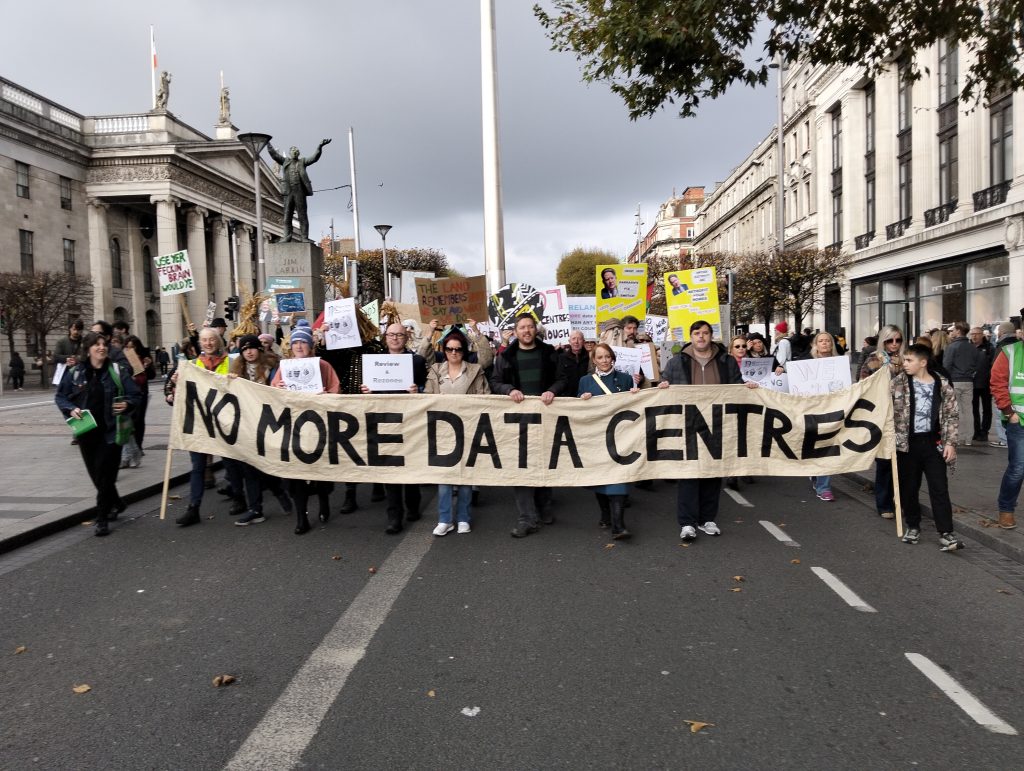
On November 7th over 2,000 participated in a protest march in Dublin. The action was against data centres. There was a range of ages and organisations represented, from children to grandparents, environmental and community groups as well as political parties. It was part of a co-ordinated Europe-wide response to a growing problem.
There are a number of reasons to oppose data centres and those at the protest voiced a variety of objections. One of the most commonly expressed complaints is their massive consumption of energy, often 24 hours a day. They compete with houses, schools and hospitals in this regard and the figures for the past decade show the increase they have made in consumption.
In the case of Ireland the Central Statistics Office (CSO) shows that data centres accounted for just 5% of consumption in 2015, but this had skyrocketed to 23% in 2025 (CSO.ie). This resulted in Irish households paying an estimated 715 Euros more in electricity bills from 2015 to 2023. This trend is likely to continue under current conditions. Campaign group Friends of the Earth predicts in a report that if that is the case, costs on households could mean an additional 1.43 billion Euros in electricity bills by 2034 (friendsoftheearth.ie).
Environmental concern can be found in their use of water. Data centres use huge amounts for their cooling systems. This puts pressure on local water supplies, especially during periods of drought or water restrictions. This is not a purely theoretical point in the case of Ireland. An indication of the general governmental attitude towards water usage can been seen in this year’s 2 and a half month ban on the use of hosepipes during summer. This was applied in Dublin and a number of other areas. However, an exemption was made for business during the ban (RTE, 22nd July 2026).
To put water use in perspective, total data centre water usage in Ireland was around 1 billion litres in 2025. Academics from universities in Ireland and Catalonia estimated in a recent joint report that this was equivalent to 18.5% of the consumption of occupied households in the Republic during that period (Irish Times 24/9/26). Over 95% of this water was consumed by the Mark Zuckerberg controlled Meta (Facebook, Whatsapp) alone.
Another reason sometimes forwarded in favour of data centres is the job creation that supposedly results. Its true they may employ workers during the construction phase of a project, but once up and running, data centres don’t need many people on an ongoing basis. Even those who remain once a data centre is established, don’t stay in the jobs very long. Data centre operations in Europe and Ireland show a low employee retention rate paired with a relatively short median tenure of 1.8 years. Linkedin data shows a high job turnover, with a minimum of 1,100 professionals changing jobs in a year (Savillis.ie). There is also the increase in AI services, which data centres’ enable. This deskills labour and puts human jobs at risk.

A further concern is the way the data centres are tied-in to the military-industrial complex. The ones in Ireland operated by Google, Microsoft and Amazon host cloud and AI infrastructure that support digital economies and military-connected cloud systems (KPMG.com). Human rights organisations such as the Irish Council for Civil Liberties have raised complaints about this, including the fact that Irish-based storage of data is tied to military and surveillance operations linked to foreign occupations and wars (ICCL.ie). Officially the Irish state claims to be neutral, but ever since World War 2, this has been more a form of neutrality that leans towards certain powers rather than others. The updating of technology is therefore really a continuation of a long-standing approach to intelligence gathering and geopolitics.
Data centres are clearly problematic. Those who have joined the opposition to them hold a combination of motivations, as can be seen in the broad demographics and organisational diversity of those who took part in the recent demonstrations. Along with this multiplicity of people, there is a variety of tactics that can be applied to the issue. At one end of the spectrum, there is the signing of a petition or marches like the ones held in Dublin. A march has its place. It at least raises greater awareness that a problem exists. The difficulty is often that petitions and marches ultimately only reinforce people’s sense of passivity, since they entail appealing to politicians to fix the very ill they created in the first place.
Further along the continuum is a perspective that argues ordinary people should directly own and control resources in society. Existing community-based groups certainly have the potential kernel of this view within them. This is something that should be encouraged. With ownership and self-management of what is produced, we can decide if we want data centres, where, when and how. In such circumstances the environment we are all part of will not be put under strain, workers and communities will decide what work needs to be done and whether we really want to support the mass killing of ordinary people elsewhere.
As for tactics, direct action is a more empowering approach. This is one where we intervene directly to change a particular situation. Instead of asking others to fix something for us, we do it ourselves here and now. There is not much sign of such activity in Ireland to be honest, but it has happened elsewhere in relation to data centres. As part of the same weekend of continent-wide initiatives, activists from the direct action group Geef Tegangas physically occupied a Microsoft data centre in Westpoort, Amsterdam. They drew attention to the use of its services by the Israeli military and Trump’s Immigration and Customs Enforcement (ICE) agency (The Guardian 6/11/26). It’s a small contribution compared to the much bigger series of actions required to achieve deeper change, but it does point to a method and aim that is likely to be more effective in the long run.
To sum up, the march in Dublin was a small component of a much larger move to oppose data centres. Due to the complex mix of participants, motivations and tactics of the wider movement, we can say it should be supported, but with a critical eye towards some aspects of what is happening. Get involved if you can.