
Few would deny that a general strike poses a blatant challenge to big business and government. Unlike many other forms of struggle, it demands a high degree of working class activity and organisation at rank-and-file level. The British General Strike of 1926 illustrates this very clearly.
The class conflict of 1925-6 was not simply a response to the economic difficulties facing the coal industry during this period. It was the culmination of offensives and retreats by both big business and the workers movement since the First World War. After the massive defeats of 1921 the workers movement only regained its self-confidence slowly. The number of strikes gradually rose through 1924.
In 1925, the employers again tried to force down working class living standards. The mine-owners proposed a 25% cut in wages, and a return to the eight-hour day. There was mass support for the miners. Baldwin, the Prime Minister told trade union leaders that the Government would not grant a subsidy, which would maintain existing wage levels. He argued that all the workers of this country had to take reductions in wages to help put industry back on its feet. But a few days later, the Government gave way and granted a subsidy. The apparent victory was hailed as Red Friday. Years later, asked why they had given way, Baldwin, replied ‘We were not ready‘.
The state used the time between then and the following May, which was when the subsidy was due to run out, profitably. lt divided the country into ten regions, each under a Civil Commissioner. Eighty eight Voluntary Service Committees were set up to keep local services in operation. The police force was enlarged through a massive recruitment of Special Constables. The right-wing Organisation for the Maintenance of Supplies was created. Although it was supposedly an unofficial body, it enjoyed full Government support. In autumn 1925, twelve leading members of the Communist Party (CP) were imprisoned under the 1797 lncitement to Mutiny Act.
A motion at the TUC’s annual conference, which called for a degree of organisation, was referred to the General Council. The CP, and the Minority Movement (a CP-dominated rank and file organisation encompassing, at least on paper, representatives of almost a million workers) tended to reinforce this inactivity. Following Leninist notions of ‘leadership’, they concentrated their efforts on putting demands to the TUC. This became a substitute for advancing concrete ideas for rank-and-file activity.
The Party told workers to ‘follow the TUC and insist on the formation of the Workers Alliance under the supreme authority of the General Council‘. Throughout 1925, they increasingly supported the ‘left-wing’ members of the General Council and hailed them as ‘an alternative political leadership.’ On January 8th 1926, the Party put forward the slogan of ‘All power to the General Council.‘ The subsidy to the mines ran out, and negotiations began. The tone of these was illustrated by J.H. Thomas, the railway workers leader, who revealed that ‘I have never begged and pleaded like l begged and pleaded all day today‘. The Government replied by sending troops to South Wales, Lancashire and Scotland. Two battleships, three destroyers and a troop ship were stationed in the Mersey. The Government broke off negotiations.
The strike began on May 3rd. The BBC offered its services to the state. On May 2nd, the Government had invoked the Emergency Powers Act. It enabled the state to take whatever measures it saw fit to maintain ‘law and order’. They commandeered paper supplies, and Winston Churchill edited the British Gazette, the Government’s daily mouthpiece – a valuable propaganda weapon. At High Mass in Westminster Cathedral, Cardinal Bourne declared that the strike was a ‘sin against the obedience which we owe to God‘. Picket lines were smashed.
On May 6th a battalion of Grenadier Guards escorted by twenty armoured cars, moved into the docks and set up Lewis guns at vantage points. Riots in Leeds, Hull and Glasgow were put down. By May 11th, the Cabinet was preparing an Order prohibiting banks from paying out money to any person ‘acting in opposition to the National Interest‘. The state machinery showed, beyond any doubt, which side it was on.
The trade union leadership gave away its position at the end of the strike. Thomas revealed in the Commons that ‘What I dreaded about this strike more than anything else was this, if by any chance it should have got out of the hands of those who would be able to exercise any control’. They insisted throughout, that the strike was completely unrelated to politics. Despite the activities of the bureaucracy, rank and file solidarity grew daily. Traditional divisions and sectional splits were broken down. The most visible form this took was the formation of Councils of Action. The form these took varied. Generally, they were based on local Trades Councils. The Vale of Leven provides a useful example of a well-organised area. lts subcommittees were:- 1. Organisation of strike 2. Propaganda Commissariat 3. Relief to strikers 4. Defence corps – not very common 5. Transport 6. Building trades. Each committee would have a convenor.
However, in many cases a single industry would dominate, as at Braintree, Norwich, Wolverhampton, etc, where railway workers played a leading part. In Wales the miners tended to control policy. Most Councils suffered from the extreme haste with which they were established, although in for example, Hull and Preston, they had been set up nine months previously. Leeds possessed four rival strike committees, mutually jealous, and pre-occupied with a fight for the direct telephone line to London. Yet throughout, every Council or committee was local in character. Few meaningful links were forged between them.
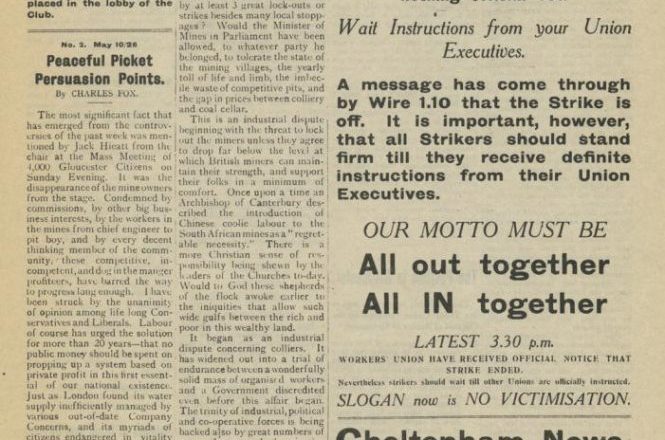
The beginnings of federations appeared only in Merseyside Dartford, and in Northumberland and Durham, where a general council was established. The potential power of Councils of Action was shown most vividly in the Newcastle area. The Civil Commissioner, Sir Kingsley Wood, was forced to negotiate with them and ask for concessions. Vehicles required special permits, issued by the local committees. Bulletins were produced throughout the country, although the TUC General Council attempted to suppress the Bradford Worker and the Preston Strike News. The strike grew daily. The wave was built up and sustained entirely by rank-and-file efforts. The trade union bureaucracy played very little part. However, the General Council retreated after nine days and called the strike off. They feared the power of the working class far more than that of the ruling class. Initially the strikers refused to accept this. Twenty-four hours after the official ending, 100,000 more workers had come out, but returned to work after instructions by union officials. The demoralisation that followed paved the way for the defeats in the following years. Living standards were cut back and shopfloor organisation smashed.
After years of indoctrination, the notion of dependence on leaderships has become deeply embedded in the British working class. Inevitably, this leads to ‘helplessness’ in the face of betrayals. As we have said, this was reinforced by the political perspectives of the CP and the Minority Movement. Today, serious revolutionaries and industrial militants must break with the idea of putting demands on the TUC and the Labour Party. That merely reinforces their authority and the existing power structure in the workers movement. The General Strike illustrates more than anything else the need for militants to build up independent organisation through class-wide activity.