
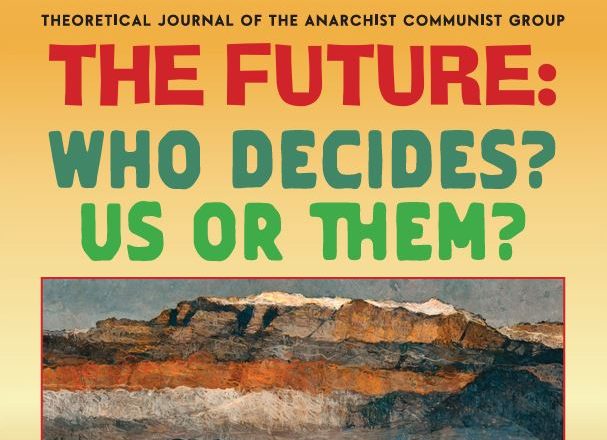
This is the 8th edition of our theoretical magazine in which we discuss issues in more depth. Articles include:
Dossier on AI, Work in the Future Society, Age Verification, the General Strike, Mujeres Libres, and a letter from a reader on veganism.
Editorial
Now and tomorrow
Now: Hope in Every Heart or Business as Usual?
Andy Burnham’s accession to power doesn’t mark any radical change in the direction of the Labour Party. He backs the Home Secretary Shabana Mahmood’s immigration reforms, increasing the wait for indefinite leave to remain from five years to between 10 and 20 years. He supports expanding the use of detention centres. He wrote recently in The Times that “Increasing our national security, in every sense, will be my first priority,” and that arms manufacture would be central in “regenerating and reindustrialising the country.” He threatened that he would “not be squeamish about cutting welfare” to invest more in the arms industry.
He intends to proceed with the £31bn Dreadnought-class boats and with the building of Trident nuclear submarines. He urged EU countries to supply Ukraine with Patriot missiles. He signed a military AI deal with Ukraine, accessing Ukraine’s Avengers AI Labs database. This huge AI database holds data collected by thousands of daylight cameras and infrared sensors across the war zone in Ukraine. They capture footage of millions of objects and the data is then fed back to the Avengers Lab to train new AI models. This will be used to protect military bases from “protesters and hostile actors trying to gain intelligence.” The Burnham administration also will work with Ukraine to explore the development of next-generation low-power AI chips to power drones and robotics.
Burnham appointed Kanishka Narayan as the first AI minister, signalling Labour support for AI, whilst coming out with rhetoric about independence from US Big Tech.
He continues to back Israel and its genocidal policies. Whilst we have experienced the hottest summer on record, Burnham talks about new drilling for oil and gas in the North Sea, exhibiting a complete unconcern about the connection between fossil fuel and climate change. He talks about a “business-friendly socialism”, as if such an obscene coupling was either possible or desirable.
The Future Society
“A map of the world that does not include Utopia, is not even worth glancing at, for it leaves out the one country at which Humanity is always landing… Progress is the realisation of utopias.”
Oscar Wilde
The theme of this issue is ‘The Future Society’. This came about because of our experience of people asking questions about what an anarchist communist society will be like, such as ‘How will it be possible?’, ‘What about crime?’, ‘What about jobs that no one wants to do?’ When many Marxists, and others, envisage a future society it usually involves automation and advanced technology, including AI. While we reject ‘anarcho-primitivism’ (see Issue 7 of Stormy Petrel), we take a critical approach to technology, especially AI. We need to ensure that it will actually enhance our lives as well as be compatible with environmental and resource concerns.
In order to address some of the questions about an anarchist communist society, in each topic we first address the reasons why the status quo is a disaster, both for the working class and the planet. We then also look at the struggles going on today. The attacks on workers’ organisation, surveillance, the insidious insertion of AI into all areas of life, the environmental effects of resource plundering, war, and the drive for growth at any cost, not only have tragic consequences today, but will make it harder for us to create the future we want. We will only be able to collectively create an anarchist communist future if we overthrow capitalism and begin to establish a vision and the foundations for this society.
We have to envision a different future. There has been an ideological onslaught over the past few decades with the capitalist slogan of ‘There Is No Alternative’ advanced over and over again. Any idea of an alternative future is mocked and laughed at. The 19th century vision of a stateless, classless and free society shared by socialists and anarchists is rarely addressed, and dull grey reformism is the order of the day. This was apparent at this year’s Tolpuddle event, where an array of trade union speakers on AI failed to voice any real opposition to it, but just talked about tinkering with it and applying a few cosmetic measures. Any radical vision of a different future is sorely lacking in today’s discourse.
We need the attractive concept of a different and better future, rather than just disgust and despair at the present. This will act as an inspiration to struggle in the present, to give time and effort to fight for social justice, knowing of the possibility of a better world. If we do not have a clear alternative, we surrender territory to those who peddle ‘No Alternative’, or who posit ghastly dystopian futures.
We have included a text from William Morris in this issue, because he exemplifies those 19th century revolutionaries who had an optimistic vision of an alternative future. As he said, “At the risk of being considered dreamers therefore it is important for us to try to raise our ideals of the pleasure of life; because one of the dangers which the social revolution runs is that the generation which sees the fall of Capitalism, educated as it will have been to bear the thousand miseries of our present system, will have far too low a standard of refinement and real pleasure. It is natural that men (sic) who are now beaten down, by the fear of losing even their present pitiful livelihood, should able to see nothing further ahead than relief from that terror and the grinding toil under which they are oppressed.”
Burnham has realized in a perverted way that there is a thirst for social justice among many, lacing his speeches with talk of “hope in every heart” and “a redistribution of power”. Of course, just like Starmer, his promises will be proved to be empty. Time then to advance an authentic vision of a different society built on that social justice.
This issue of Stormy Petrel contains two historical articles, on the 1926 General Strike and on the Spanish women’s organisation Mujeres Libres. This is not out of some fusty notion of nostalgia, but because inspiring lessons from the past can help power our ideas of a future society.